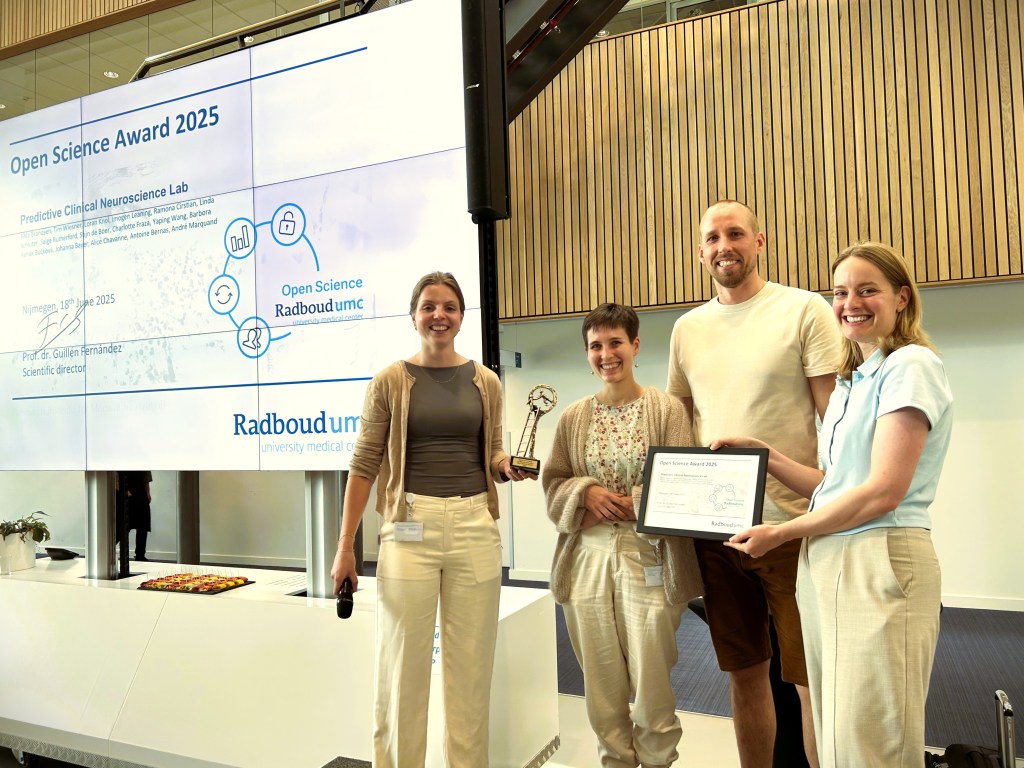
The PCN Lab has been awarded the Open Science prize from Radboudumc. Congratulations everyone!
Open Science Contribution – Predictive Clinical Neuroscience Lab@RadboudUMC
Mission statement: The Open Science mission of the Predictive Clinical Neuroscience (PCN) lab is threefold: (i) we want to develop methods that promote reproducible and generalizable analysis within neuroscience, psychology and psychiatry, (ii) we want to conduct transparent and replicable research, (iii) we want to teach and promote these open science practices across our department at the UMC, the broader scientific community and the general public.
Contributions to open science and its significance: Our main contribution to the Open Science community is the machine learning algorithms developed within our lab, disseminated through GitHub (a code-sharing platform) and made accessible via the PCN Toolkit. This is one of the first openly available software packages that makes training and developing large neuroimaging models, through so called normative models, broadly accessible. The toolbox was first published in 2020 and has since been actively developed and maintained by various members of our team.
We provide detailed tutorials, documentation, and technical support to ensure the accessibility and reusability of the code by researchers across disciplines. Additionally, it is standard practice in our lab that for each published paper, the corresponding code is made freely available online, along with the data, when possible, so that any researcher can reproduce our analyses without concerns about model settings or dataset inconsistencies.
A key infrastructure component that further allows easy access to our models is the PCN Portal, an user-friendly online platform that makes transfer learning of our models accessible to everyone. Researchers can upload small datasets to a secure, centralized server and run our machine learning algorithms with the click of a button. This promotes collaboration across institutions and makes clinical research more open and accessible, without compromising data privacy.
Because the data regulatory landscape has become increasingly restrictive in recent years, our lab has spent much time developing methods for federated learning; a decentralized machine learning paradigm that crucially does not involve data sharing, but instead relies on model sharing and transferring. Our publicly available methods will significantly lower the threshold for scientific collaboration in the future, and we aim to lower that threshold even further by extending the PCN portal with a rich set of federated learning features.
Beyond standard open science practices: Within the lab, we try to go beyond standard Open Science practices by emphasizing open communication and dissemination at every part of the research. This includes releasing pre-trained large neuroimaging datasets, codebases, and educational content publicly. We contribute to internal training resources (e.g., the Donders Neuroimaging and fMRI Toolkits) and international platforms like Repronim and the OSSIG, helping scale best practices across institutions. Notably, we have made a large investment in teaching these relatively complicated methods and share these resources not only in-house but also with the wider scientific community:
Teaching normative modeling at the Computational Psychiatry Conference in Tübingen, the Computational Psychiatry Course in Zurich (CPC), and at the Dutch Symposium on Federated Learning in Amsterdam.
In terms of dissemination, we try to share our science widely:
- Through the PreCognition website: “Learning Latent Cognitive Profiles to Predict Psychosis“
- By currently producing a documentary exploring the impact of our research on predicting psychosis
- By writing about our research for both internal audiences at the UMC and the wider public on platforms like inspire the mind.
- By presenting our research at public science events such as Pint of Science and the Radboudumc Investment Day
Conclusion: Our team at the PCN Lab strives to keep Open Science at the forefront of all our scientific work. We work on freely available software, community infrastructure, educational materials for students and researchers, and dissemination efforts aimed at both the scientific community and the general public. Members of our team actively participate in organizing committees of conferences, initiatives, and summer schools that promote Open Science, knowledge exchange, and international collaborations.
Members/Contributors:
- Prof. Andre Marquand (Principal Investigator)
- Dr. Antoine Bernas (Postdoctoral Research Associate)
- Dr. Alice Chavanne (Postdoctoral Research Associate)
- Dr Johanna Bayer (Postdoctoral Research Associate)
- Dr Barbora Rehák Bučková (Postdoctoral Research Associate)
- Dr. Yaping Wang (Postdoctoral Research Associate)
- Dr. Charlotte Fraza (Postdoctoral Research Associate)
- Stijn de Boer (Software Developer)
- Saige Rutherford (PhD student)
- Linda Schlüter (PhD student)
- Ramona Cirstian (PhD student)
- Imogen Leaning (PhD student)
- Loran Knol (PhD student)
- Tim Wiesner (Masters Student)
- Mila Brandsen (Research Assistant)
 Predictive Clinical Neuroscience Lab